
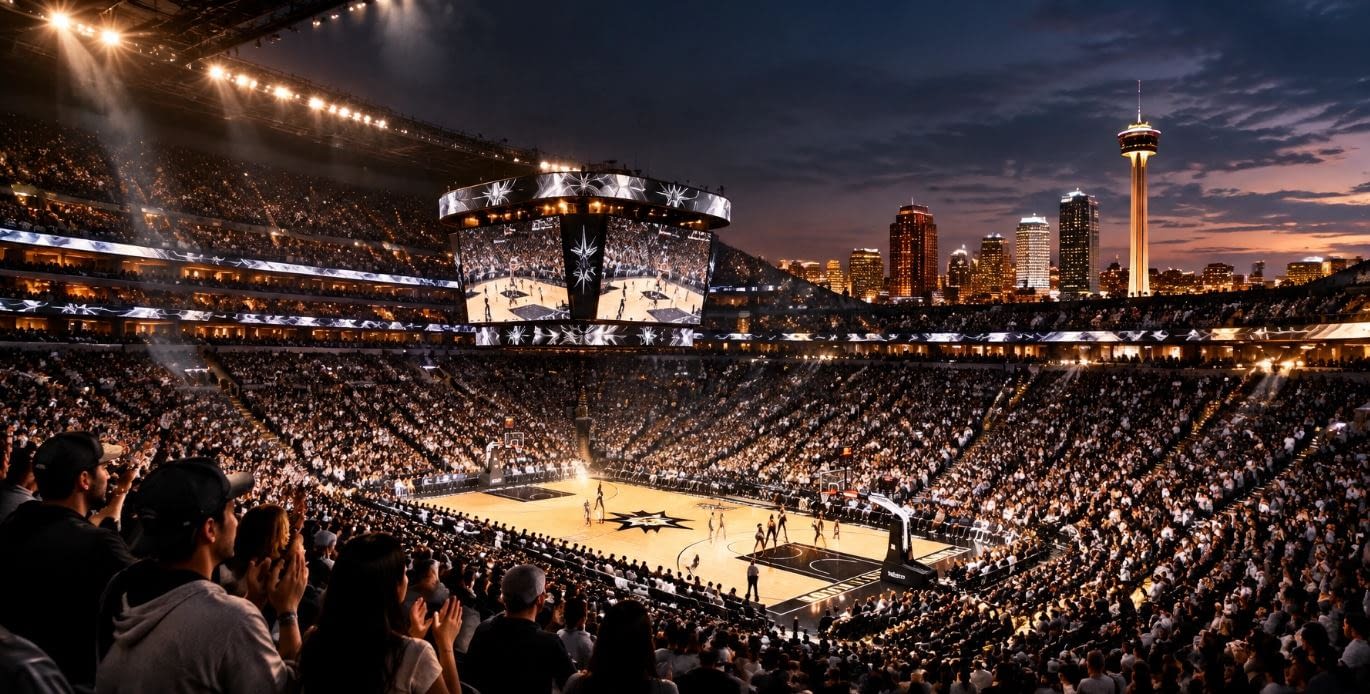
In San Antonio, the Spurs are part of the city’s identity. The silver and black fill the arena, the Coyote keeps the crowd moving, and a playoff run becomes a conversation everywhere from the breakfast table to the River Walk.
After a trip to the 2026 NBA Finals, one question is on everyone’s mind: Could the next great Spurs dynasty be taking shape?
The answer will take time. Dynasties are not built in one season. But the Spurs’ history, culture, young talent, and deep connection to San Antonio make the 2026–27 season one of the most exciting chapters in franchise history.
From the ABA to a San Antonio tradition
The franchise began in 1967 as the Dallas Chaparrals, one of the original teams in the American Basketball Association. After six seasons in Dallas and a brief attempt to broaden its appeal as the Texas Chaparrals, the team struggled with attendance and financial difficulties.
In 1973, the franchise moved south to San Antonio. The newly renamed San Antonio Spurs played their first home game at HemisFair Arena on October 10, 1973, against the San Diego Conquistadors.
The team’s early years were not easy. Crowds were small, and the Spurs began their first San Antonio season with a 1–6 record. Then the franchise acquired George “The Iceman” Gervin, an electric scorer whose smooth style and unshakable composure gave San Antonio its first unforgettable superstar.
The Spurs joined the NBA in 1976 when the ABA folded. From there, the organization began building a tradition around:
- Tough, disciplined defense
- Unselfish ball movement
- International scouting
- Player development
- A city willing to stand behind its team
The classic silver and black remain unmistakable. In more recent years, the team’s City Edition uniforms have also celebrated San Antonio’s art, culture, and heritage.
For a detailed historical overview, the Texas State Historical Association’s history of the San Antonio Spurs offers an excellent look at the franchise’s journey.
Who brought the Spurs to San Antonio?
The Spurs did not arrive because of a distant corporate decision made in a boardroom. They came to San Antonio because local business leaders believed the city deserved a major professional sports team, and they were willing to put their money and reputations behind that belief.
In 1973, a group of San Antonio businessmen organized as Professional Sports, Inc. brought the Dallas Chaparrals to the city. The group included:
- Angelo Drossos
- B.J. “Red” McCombs
- John Schaefer
- Art Burdick
Drossos and McCombs were the primary figures who drove the acquisition and relocation. Initially, the group negotiated a three-year lease for the team with an option to purchase. After the franchise’s first season in San Antonio, the ownership group exercised that option and bought the team outright.
Angelo Drossos became an important public face of the franchise. He helped guide the organization through its transition from the ABA to the NBA and played a major role in shaping its early identity.
Red McCombs, meanwhile, went on to become one of San Antonio’s most influential business and civic leaders. He later purchased control of the Spurs and repeatedly emphasized the importance of keeping the team in San Antonio. His family would later rejoin the Spurs ownership group.
The name “Spurs” was selected through a public contest and reflected the region’s ranching heritage. It was a fitting choice: distinctly Texas, connected to the land, and strong enough to grow with the franchise.
That local beginning still matters. The Spurs were not simply assigned to San Antonio. Local people fought to bring them here, helped give them a name, and created the foundation for what became one of the NBA’s most respected organizations.

The championship years and their legends
The Spurs have won five NBA championships: 1999, 2003, 2005, 2007, and 2014.
The first title came in 1999, when David Robinson and Tim Duncan formed the legendary “Twin Towers.” Robinson, known as “The Admiral,” brought leadership, defense, and professionalism. Duncan became the steady foundation of the franchise and one of the greatest power forwards in basketball history.
The next era introduced the “Big Three” of Duncan, Tony Parker, and Manu Ginóbili.
Parker brought speed, confidence, and fearless drives to the basket. Ginóbili brought creativity, energy, and an unconventional style that made him one of basketball’s most entertaining players. Together, they represented the Spurs’ willingness to develop talent from around the world.
Coach Gregg Popovich and executive R.C. Buford helped build an organization that could keep winning as the league changed. The Spurs adapted from a defense-first team into one of the NBA’s best examples of modern, unselfish offense.
The 2014 title captured what fans loved about that era. The Spurs trusted the pass, moved the ball, found the open teammate, and played with purpose. San Antonio had stars, but the team itself was the attraction.
2026 was just the beginning
The 2025–26 Spurs turned promise into a Finals appearance. They finished the regular season 62–20, defeated the Oklahoma City Thunder in a seven-game Western Conference Finals series, and returned to the NBA Finals.
New York won the championship series 4–1, but San Antonio’s young core gained valuable postseason experience. A Finals appearance gave the team more than national attention. It showed its developing players what the highest level of NBA competition demands.
Victor Wembanyama became the youngest Defensive Player of the Year in NBA history and the award’s first unanimous winner. Keldon Johnson won Sixth Man of the Year. Rookie Dylan Harper showed what he could contribute under playoff pressure.
With Stephon Castle, De’Aaron Fox, Devin Vassell, and the rest of the roster alongside them, the Spurs have plenty of room to grow. Wembanyama’s defensive presence changes the geometry of the court, while the team’s younger players continue learning how to perform in high-pressure moments.
The Spurs Coaching Tree: A Model Franchise That Builds Leaders
The Spurs did not just win championships — they became a leadership academy for the entire NBA. General managers, head coaches, and team presidents across the league trace their careers back to San Antonio. The organization’s culture, preparation, and standards became a kind of curriculum, and for decades other teams tried to hire a piece of it.
Assistant coaches who became NBA head coaches
What stands out is not just the number of names. It is the range. Some came through the NBA bench, some through player development, and some through the Spurs’ broader basketball ecosystem, including Austin. Together, they show that San Antonio did not simply teach X’s and O’s. It taught leadership, preparation, communication, and how to build a team identity.
Front office executives who went on to lead other teams
San Antonio’s influence reached far beyond the coaching bench. The Spurs became one of the league’s most important executive pipelines, with leaders carrying pieces of the organization’s discipline, long-range thinking, and talent-evaluation philosophy into front offices across the NBA.
The coaching tree also extends through former Spurs players and basketball minds who carried the franchise’s culture into new roles. Steve Kerr played for the Spurs under Gregg Popovich, then later served as General Manager and President of Basketball Operations for the Phoenix Suns before becoming head coach of the Golden State Warriors. Several former Spurs players also went on to head coaching careers, including Doc Rivers with Orlando, Boston, the LA Clippers, Philadelphia, and Milwaukee; Monty Williams with New Orleans, Phoenix, and Detroit; Avery Johnson with Dallas and New Jersey; Vinny Del Negro with Chicago and the LA Clippers; and Terry Porter with Milwaukee and Phoenix. Monty Williams also served as the Spurs’ Vice President of Basketball Operations.
For a market that is not one of the NBA’s largest, San Antonio’s reach is remarkable. The Spurs were never merely a good team. They were proof that culture, patience, international scouting, player development, and unselfish basketball could beat bigger budgets — and that the people who learned to do it in San Antonio would be trusted to do it everywhere else. When other organizations want to change a culture, they hire someone who learned it from the Spurs. That is what a model franchise looks like.
What the Spurs mean to San Antonio
The Spurs are more than a basketball team. They are part of San Antonio’s civic identity.
The silver and black function as a shared language that crosses neighborhoods, generations, and socioeconomic lines. A grandmother, a parent, and a child in a Wembanyama jersey can all watch the same game and feel connected to the same history.
The team also serves as a global ambassador for San Antonio. Championship celebrations, international players, national broadcasts, and years of consistent excellence have helped introduce the city to audiences around the world.
Just as important, the Spurs culture mirrors many values San Antonio holds close:
- Humility
- Family
- Hard work
- Teamwork
- Loyalty
- A multicultural and working-class spirit
“The Spurs Way” is celebrated as much as the championships. It means unselfish play, limited ego, preparation, and putting the team above the individual.
That identity extends into the community through Spurs Give, the official 501(c)(3) nonprofit organization of Spurs Sports & Entertainment. Since its founding in 1988, Spurs Give says it has invested $28 million in the community through grants, programs, and player engagement.
Its work includes:
- The Spurs Youth Basketball League
- Youth sports and service programs
- Operation Renovation, which supports improvements to youth facilities
- Community grants and nonprofit partnerships
- Food distributions with the San Antonio Food Bank
The Coyote is another important part of that connection. A beloved Hall of Fame mascot, the Coyote is more than an in-arena entertainer. He is a recognizable community ambassador who brings the team’s personality to schools, hospitals, charitable events, and family programs.
The 2026 Finals also gave the country a charming glimpse of San Antonio’s fandom through the “Spurs Nuns,” Salesian Sisters who became national favorites while cheering from courtside in Spurs jerseys over their habits. Their joyful support, and their visible connection with players such as Wembanyama, captured something essential about the city: San Antonio shows up for its team with faith, humor, warmth, and heart.

Why the 2026–27 season is so exciting
The season ending in 2027 brings a new challenge. The Spurs enter it with a Finals appearance behind them and a target on their backs.
Can Wembanyama build on his dominant defense? Can Castle and Harper take another step? Can head coach Mitch Johnson turn the lessons of last June into better execution when games are close? New lead assistant Billy Donovan adds experience as the team works to sharpen its offense.
Fans will get an early measuring stick when the Spurs open at home against the Oklahoma City Thunder on October 20, 2026, at 8:30 p.m. local time, with national coverage on NBC. It will be a rematch of the 2026 Western Conference Finals.
Then, on December 25, 2026, at 11:00 a.m. local time, the Spurs will face the Knicks at Madison Square Garden in a Christmas Day Finals rematch, televised on ABC/ESPN. Those games will not decide a championship, but they will offer an early look at how ready this group is to take another step.
A dynasty is earned over years. Yet the ingredients that once made the Spurs special (talent, development, defense, teamwork, and belief in the team) are visible again.
The 2026 season announced San Antonio’s return to the NBA’s biggest stage. The 2027 season is a chance to show that the best may still be ahead.
Protect what matters during a big Spurs season
Big seasons bring big energy to San Antonio, and they can also bring busy homes, packed restaurants, game-night events, and new opportunities for local businesses.
Whether you are protecting your home, your car, or a business that thrives on Spurs game nights, Trutela Insurance can help you review your coverage with a trusted advisor. As an independent agency based in Windcrest at 8200 Windway, Trutela shops more than 50 insurance carriers to help you find the right protection at the right price.
Explore personal insurance options, learn more about commercial insurance, or contact Trutela at (210) 757-4520. Your coverage should keep up with your life, your business, and the city you call home.
Trutela Insurance, managed by Joseph Gutierrez, CIC.