
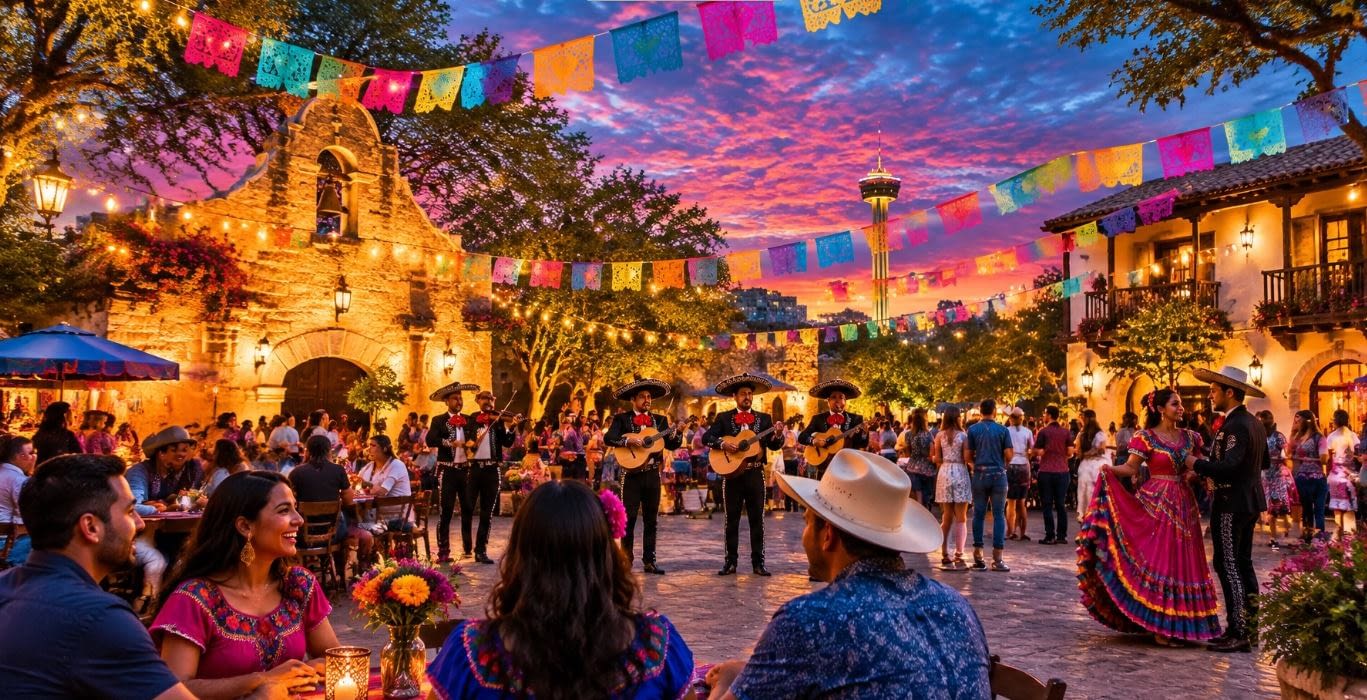
If you have ever wandered through San Antonio during Fiesta, you already know the city does not simply host a festival. San Antonio becomes the festival.
For 11 days, the city fills with parades, music, medals, cascarones, food, dancing, community fundraisers, and enough confetti to turn a perfectly respectable sidewalk into a celebration. Locals plan around it. Visitors book hotels months ahead. Families pass down traditions, and volunteers return year after year because Fiesta is not just something San Antonio attends. It is something San Antonio builds together.
At the center of that story has long been NIOSA: A Night in Old San Antonio, the Conservation Society’s beloved celebration at La Villita.
But in September 2026, NIOSA entered a bittersweet new chapter. The San Antonio Conservation Society announced that it is pausing NIOSA indefinitely, meaning the event will not be held during Fiesta 2027. The board voted 17–10 to suspend the event after attendance fell 48% from pre-pandemic levels, operating costs kept rising, and NIOSA posted four consecutive years of financial losses.
The decision is difficult news for San Antonians. It is also a reminder of just how much this one event has meant to the city.
What Is NIOSA, and Why Has It Mattered So Much?
NIOSA began as a preservation fundraiser, and that purpose has never been incidental. Its motto, “A Celebration for Preservation,” captures the heart of the event.
Held inside La Villita, one of San Antonio’s oldest neighborhoods, NIOSA brought together food, music, architecture, and culture across 14 distinctive areas. More than 155 food, beverage, and atmosphere booths filled the historic setting, with multiple stages offering entertainment throughout the celebration.
In recent years, approximately 85,000 people attended NIOSA. Behind the scenes, roughly 6,500 volunteers made the event possible. Many came from second- and third-generation NIOSA families, while others traveled from across Texas and the United States to help cook, serve, organize, and preserve the tradition.
The event also raised approximately $1.5 million annually for historic preservation programs, including:
- Restoration of historic properties and parks
- Heritage Education Tours
- Community tours and educational seminars
- Scholarships
- The Conservation Society’s resource library
- Historic house museums
So when visitors bought a plate of food or a cold drink at NIOSA, they were not just enjoying a night out. They were helping protect the places and stories that make San Antonio feel like San Antonio.

How Long Has NIOSA Been Part of San Antonio?
NIOSA’s roots reach back to 1936, when the Conservation Society of San Antonio hosted a harvest festival on the grounds of Mission San José.
Two years later, in 1938, the event evolved into the “Indian Festival,” a one-night fall street fair inspired by the fiestas of San Antonio’s early days. That first festival raised $336.11 for preservation efforts: a modest amount by today’s standards, but a meaningful beginning.
From 1936 through 1946, the celebration continued under several names, with interruptions during World War II in 1943 and 1945. In 1944, it was known as the “River Festival.”
In 1946, the City of San Antonio invited the Conservation Society to move the celebration so it could coincide with Fiesta. The festival was officially named A Night In Old San Antonio for the first time in 1948.
By 1958, it had expanded to four nights. In 1966, the name was officially registered and trademarked.
That means the tradition’s roots stretch back approximately 90 years, while the NIOSA name and Fiesta-era format have been part of San Antonio’s identity for generations. The event’s 2026 presentation marked its 79th presentation historically, continuing a remarkable legacy from a small preservation fundraiser to one of the country’s best-known cultural festivals.
What Made NIOSA Feel So Special?
Part of NIOSA’s charm was that it never felt mass-produced.
The food was made by volunteers in certified NIOSA kitchens. Every booth was operated by dedicated Conservation Society volunteers. Some families returned for decades, teaching younger generations the recipes, routines, and small details that made the event work.
In the early years, volunteers cooked in their own homes. Chili stands were introduced in 1947, modeled after historic plaza chili stands. Members contributed homemade desserts, candies, and flowers from their own gardens. If someone could not make candy, they donated a dollar instead.
By 1953, the event had grown beyond the capacity of members’ kitchens. The Society began buying pies from San Antonio bakeries and ordering 1,000 dozen tamales.
The scale eventually became enormous. A typical NIOSA season required approximately:
- More than 17,000 pounds of beef
- Over 11,000 pounds of chicken
- About 5,000 pounds of sausage
- More than 3,000 turkey legs
- Over 25,000 buns, rolls, and bolillos
- Nearly 30,000 tortillas
- More than 2,000 pounds of masa
- Over 15,000 pounds of fresh fruits and vegetables
- More than 1,000 pounds of guacamole
Those numbers are fun to imagine, but they also tell a deeper story: NIOSA was a remarkable community operation powered by thousands of people working together.
Why Did NIOSA Pause in 2027?
The Conservation Society’s September 16, 2026 announcement was not about a lack of love for NIOSA. It was about whether the event could continue sustainably while still supporting the Society’s preservation mission.
Attendance had fallen 48% since the pandemic, and NIOSA had experienced four consecutive years of financial losses. Rising operating costs meant it required roughly $600,000 simply to get the event started each year.
The event also faced a major change to its home at La Villita. Available space has been reduced by approximately 43% as La Villita Assembly Hall is converted into a food hall and restaurants are developed at Maverick Plaza.
Conservation Society President Betty Bueché explained the decision this way:
> “We are choosing to hit the pause button now so we can protect the long-term legacy of the San Antonio Conservation Society and the funding necessary to carry out our historic preservation mission.”
No timeline has been set for NIOSA’s return. Organizers have said it could come back if conditions change. One possible path would involve outside sponsorships of approximately $600,000-funding NIOSA has not traditionally sought.
For now, it is best understood as a chapter break, not necessarily an ending.
How Did Fiesta San Antonio Begin?
NIOSA is one of Fiesta’s signature events, but Fiesta itself began much earlier.
The first Battle of Flowers Parade took place in 1891. Created to honor the heroes of the Alamo and the Battle of San Jacinto, it became the founding event of Fiesta San Antonio.
The inaugural parade drew approximately 15,000 attendees. Today, the Battle of Flowers Parade attracts more than 350,000 spectators along its route, with millions more watching on television. It remains the largest parade in the country produced entirely by women volunteers.
Over time, Fiesta grew from one parade into an annual, citywide celebration coordinated by the nonprofit Fiesta San Antonio Commission. The 2026 Fiesta ran from April 16 through April 26 and featured more than 100 events.
Major traditions include:
- The Battle of Flowers Parade
- The Texas Cavaliers River Parade
- The Fiesta Flambeau Parade
- NIOSA
- Fiesta Oyster Bake
- The King William Fair
- Community festivals, concerts, cultural programs, and charity events
According to official Fiesta figures, the celebration attracts approximately 2.5 million attendees annually and generates an economic impact of more than $340 million.

What Does Fiesta Mean to the San Antonio Community?
Fiesta is San Antonio’s heritage on display.
It reflects the city’s Mexican, Spanish, German, and Texan roots, not as separate chapters, but as overlapping parts of one living community. You can see that blend in the music, food, architecture, clothing, parades, and neighborhood traditions.
For many families, Fiesta means:
- Making cascarones together
- Collecting colorful medals
- Attending the same parade every year
- Volunteering with parents, grandparents, or children
- Sharing recipes and stories
- Supporting nonprofit organizations
- Welcoming visitors to the city
It is also a major economic engine. Hotels, restaurants, retailers, event vendors, transportation providers, and local nonprofits all benefit from the visitors Fiesta brings to San Antonio.
That visitor appeal is easy to understand. People come for the food, music, history, and parades, but they return for the feeling. Fiesta offers an atmosphere that is difficult to recreate anywhere else: historic streets glowing with lights, neighbors greeting one another, performers filling public spaces, and a city proud enough to celebrate loudly.
For years, NIOSA was one of the ultimate bucket-list experiences within that larger celebration. La Villita’s historic setting made every booth feel like part of a story, and every crowded walkway offered another plate, song, or surprise around the corner.
A Tradition Worth Remembering, and Protecting
NIOSA’s pause will leave an unmistakable space in Fiesta 2027. Many locals will miss the food, the music, the volunteers, and the familiar rhythm of returning to La Villita.
But the tradition’s legacy is larger than a single event calendar. NIOSA helped restore historic places, educate generations, support preservation work, and show what can happen when a community gives its time and talent to a shared purpose.
The same spirit continues throughout Fiesta: in every parade volunteer, neighborhood organizer, nonprofit fundraiser, food vendor, musician, and family that keeps showing up.
Whether NIOSA eventually returns in a new form or takes more time to find its next chapter, its mark on San Antonio is secure. A 90-year tradition does not disappear simply because one season is paused. It lives in the people who remember it, the places it helped protect, and the community it brought together.
And if you are planning a visit to San Antonio during Fiesta, check the official Fiesta San Antonio history and event information before you travel. Bring comfortable shoes, an appetite, and a little patience for crowds. Most importantly, come ready to experience a celebration that San Antonio has built with heart.
Protecting What Matters in San Antonio
Fiesta is a celebration of community, and communities are built around homes, businesses, families, and local traditions.
Whether you are protecting your home, your car, or a business that welcomes Fiesta crowds, Trutela Insurance can help you review your coverage with a trusted local advisor. As an independent agency based in Windcrest at 8200 Windway, Trutela shops more than 50 insurance carriers to help find the right protection at the right price.
Call (210) 757-4520, visit www.trutela.com, or explore the Trutela blog for more guidance. Trutela Insurance is managed by Joseph Gutierrez, CIC.