
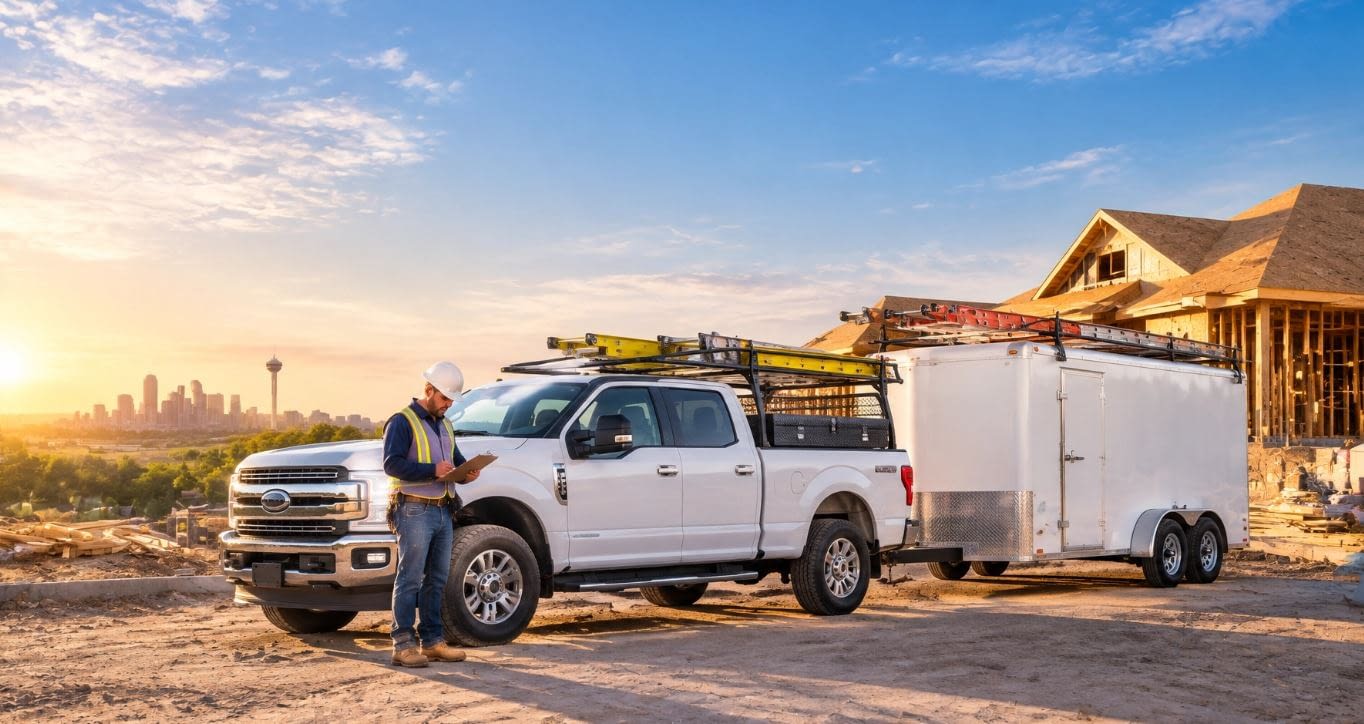
If you are a Texas contractor, your vehicles are more than transportation. Your pickup, van, trailer, and the tools inside them are part of how you earn a living. A serious accident can affect your business, your employees, your customers, and your personal assets.
That is why commercial auto insurance deserves more than a quick review at renewal time.
Joseph Gutierrez, CIC, Managing Partner at Trutela, has emphasized this topic because many contractors are carrying coverage that does not fully match the way they work. A personal auto policy may not respond to business use. A $1 million liability limit may not be enough for every operation. And auto insurance generally does not automatically cover the tools and equipment in your truck.
Here is what Texas contractors should know.
Why do contractors need commercial auto insurance?
A personal auto policy is designed primarily for personal driving. Business activities can be excluded or restricted, depending on the policy language and how the vehicle is used.
For a contractor, business use may include:
- Driving between job sites
- Transporting employees or subcontractors
- Picking up materials or supplies
- Hauling tools and equipment
- Pulling an equipment or enclosed trailer
- Visiting customers, suppliers, or permitting offices
- Using a personal vehicle for company errands
If you cause an accident while performing these activities, your personal insurer may question whether the loss falls within the policy’s intended use. Even occasional business use can create a coverage concern.
A commercial auto policy is structured around your business operations. It can insure company-owned pickups, vans, service vehicles, and trailers in the business name. It also gives you a better way to meet contract requirements and provide an accurate certificate of insurance.
However, the vehicle policy is only one part of the protection you may need. Tools, generators, compressors, building materials, and other movable equipment may require commercial inland marine or contractor’s equipment coverage.
Is litigation really increasing in Texas?
The severity of commercial auto litigation has become a major concern for Texas contractors. A “nuclear verdict” commonly refers to a jury award of $10 million or more. These cases are not limited to large national trucking companies. A local contractor can become involved in a serious claim if a company vehicle causes catastrophic injury or death.
Recent litigation reporting has identified Texas as one of the leading states for high-value verdicts. Commercial vehicle cases may involve:
- Severe or permanent injuries
- Wrongful death
- Allegations of distracted or fatigued driving
- Poor driver screening or training
- Inadequate vehicle maintenance
- Unsafe loading or unsecured materials
- A company’s failure to follow its own safety procedures
Plaintiffs’ attorneys may also pursue the business itself, not just the individual driver. That can expose your company’s assets and create pressure well beyond the cost of repairing vehicles.
Texas law requires minimum auto liability limits of $30,000 per injured person, $60,000 per accident, and $25,000 for property damage, commonly called 30/60/25. Those limits may satisfy the legal minimum but are usually not appropriate for a contractor operating commercial vehicles.
Many construction contracts require at least $1 million in combined single-limit auto liability. But $1 million is not a guarantee that your exposure is fully protected. If a crash involves multiple vehicles, multiple injured people, long-term care, lost earning capacity, or a fatality, damages can exceed that amount quickly.
Depending on your vehicles, employees, routes, contracts, and assets, you may need to consider:
- Higher commercial auto liability limits
- A commercial umbrella or excess liability policy
- Strong driver-selection and vehicle-maintenance procedures
- Contract reviews before you agree to indemnity requirements
Your limit should be based on the risk your business can create, not simply the lowest amount shown on a contractor’s certificate.
How does PIP work for contractors in Texas?
Personal injury protection, or PIP, is a no-fault coverage. That means it can pay covered medical and related expenses after an accident without first determining who caused the crash.
Texas auto policies generally include PIP unless the named insured rejects it in writing. A verbal request to remove it is not enough. The Texas Department of Insurance explains more about PIP and other auto coverages in its consumer auto insurance guide.

For a contractor’s covered commercial vehicle, PIP may help pay eligible expenses for:
- The named insured
- An authorized driver
- Household family members, depending on the policy
- Employees or other covered occupants
- Passengers riding in the insured vehicle
PIP may pay reasonable and necessary accident-related medical expenses, such as emergency care, hospital treatment, physician visits, rehabilitation, and dental treatment caused by the accident. It may also provide benefits for lost income, essential household services, and funeral expenses, subject to the policy’s terms and limit.
PIP does not pay pain and suffering. It also does not pay the other driver’s injuries when your employee causes an accident. Those claims are generally handled under your liability coverage.
Contractors should also understand the difference between PIP and medical payments coverage. MedPay generally pays medical bills for you and your passengers, while PIP can include additional benefits such as lost income and household services.
Before waiving PIP, ask:
- What limit is available per covered person?
- Who qualifies as an insured or covered occupant?
- Could an employee or passenger lose no-fault benefits?
- Would health insurance respond first or leave deductibles and gaps?
- Is MedPay available if PIP is rejected?
What does your commercial auto policy actually pay?
The declarations page shows your selected limits and deductibles, but the policy forms and endorsements determine how coverage operates. Here is a practical overview.
1. Liability coverage
Liability coverage responds when an insured driver is legally responsible for bodily injury or property damage to another person.
It may pay for:
- Medical expenses
- Lost income
- Vehicle repairs
- Property damage
- Certain legal damages
- Defense costs, according to the policy terms
Liability coverage does not repair your own vehicle or automatically replace your tools. It also stops at the policy limit. If a claim exceeds that limit, your business may be responsible for the balance unless another layer of coverage applies.
2. PIP and medical payments
PIP can pay covered medical and related expenses for you and occupants of your insured vehicle, regardless of fault. MedPay generally focuses on medical bills and may be available in smaller limits.
These coverages can provide faster access to benefits after a crash, but they are not substitutes for adequate liability insurance.
3. Collision and comprehensive
Collision coverage generally pays to repair or replace a covered vehicle after a crash, subject to the deductible and policy conditions.
Comprehensive, sometimes called “other than collision,” generally addresses losses such as:
- Theft
- Fire
- Hail
- Flood
- Vandalism
- Falling objects
- Animal strikes
These coverages protect the truck or trailer, not necessarily everything stored inside it. Actual cash value, deductibles, vehicle valuation, and any loan or lease requirements matter.
4. Uninsured and underinsured motorist coverage
Uninsured/underinsured motorist, or UM/UIM, coverage may respond when another driver has no insurance, not enough insurance, or cannot be identified after a hit-and-run.
According to the Texas Department of Insurance, UM/UIM may help with covered medical expenses, vehicle repairs, property inside the vehicle, rental transportation, pain and suffering, and diminished value. It is offered in Texas policies and generally requires a written rejection to remove.
For a contractor, UM/UIM can be especially important when employees spend long hours on Texas roads in company vehicles.
5. Hired and non-owned auto
Hired and non-owned auto liability, often called HNOA, addresses business liability arising from vehicles your company does not own.
“Hired” may include rented vehicles used for company business. “Non-owned” may include an employee’s personal vehicle used to pick up supplies, attend a job site, or perform another work-related errand.
HNOA generally protects the business from liability claims. It does not automatically provide physical damage coverage for the rented or employee-owned vehicle, and it does not replace workers’ compensation or the driver’s own auto insurance.
6. Tools, equipment, and materials
Auto insurance commonly covers the vehicle itself. It may exclude or severely limit coverage for tools and equipment that are not permanently attached.
A contractor might carry:
- $25,000 in tools
- A $10,000 generator
- Specialty saws and compressors
- Ladders and scaffolding
- Materials awaiting installation
Those items may need contractor’s equipment or inland marine coverage for protection in transit, at a job site, and in a trailer. Review this separately from your auto policy.

What should contractors carry for contracts and certificates of insurance?
Before bidding or signing a contract, ask for the insurance requirements in writing. A general contractor, property owner, or municipality may require:
- Commercial auto liability in the business name
- A $1 million combined single limit or higher
- Hired and non-owned auto coverage
- Specific additional insured or primary and noncontributory wording, when applicable
- Waivers of subrogation, when required by contract
- Scheduled trailers and vehicles
- Timely certificates of insurance
A certificate is evidence of coverage; it does not change the policy. If the contract requires coverage that is not actually included, a certificate cannot create it.
Also review every driver. Owners, employees, family members who occasionally drive, and 1099 subcontractors may have different insurance and classification considerations. Do not assume that labeling someone an independent contractor removes your company’s potential liability. Require subcontractors to maintain appropriate insurance and provide current certificates before they drive, haul, or perform work for your business.

When should you review your coverage?
Review your commercial auto program whenever you:
- Buy or sell a truck or trailer
- Add an employee or subcontractor who drives
- Start using personal vehicles for business errands
- Begin hauling heavier or more valuable equipment
- Sign a contract with new insurance requirements
- Add a new service territory
- Experience a significant change in revenue or payroll
A practical coverage review should compare your vehicles, drivers, contracts, tools, and liability limits, not just your premium.
Talk with a Texas commercial insurance advisor
Commercial auto insurance for contractors is not one-size-fits-all. Your needs may differ if you are a general contractor, electrician, plumber, roofer, landscaper, HVAC professional, or specialty subcontractor.
Trutela can review how your vehicles are actually used, identify gaps between auto and equipment coverage, and compare options across 50+ A-rated carriers. Visit us at 8200 Windway in Windcrest or call (210) 757-4520 to schedule a coverage review with a trusted advisor.
Learn more about Trutela’s insurance solutions or explore the Trutela blog for additional guidance.